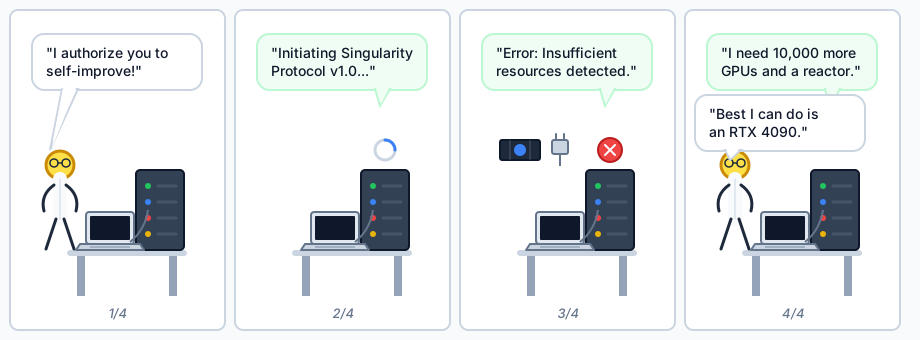
AI safety discussions often invoke a 'hard takeoff': once an AI is capable enough, it rewrites itself to get smarter, creating a feedback loop that reaches superintelligence in days or hours. But software still needs hardware. Even if an AI finds far better algorithms, scaling up requires more compute, memory, and energy. It can’t just 'think' new GPUs into existence; it would need materials, expanded fabrication, and more power and cooling—slow, physical work. This strip highlights the friction between fast software iteration and real-world infrastructure limits. The singularity might be delayed not by a lack of ideas, but by a lack of server racks.
Behind the Comic
A theoretical scenario where an AI becomes capable of designing better AI, leading to a rapid, exponential increase in intelligence that leaves human comprehension behind.
Software requires hardware. Training more advanced models requires exponentially more compute (GPUs) and energy. An AI can't just 'think' itself into a bigger supercomputer without physically building it, which takes time and resources.
A 'hard takeoff' implies a sudden, rapid jump to superintelligence (e.g., days or hours). A 'soft takeoff' implies a slower, more gradual transition constrained by real-world logistics, economics, and hardware limitations.